AGRIVOLTAICS IN THE NETHERLANDS
A PRACTICAL GUIDE FOR FARMERS
Dutch agriculture has always been built on balance. Balance between land and water. Between productivity and precision. Between innovation and practicality. Today, that balance is being tested again. Energy costs are volatile, climate patterns are less predictable, and land availability remains limited. Agrivoltaics has entered this discussion not as a trend, but as a practical response to these realities.
This article is for Dutch farmers, growers, and greenhouse operators. It explains what agrivoltaics is, how it works in the Netherlands, and when it is useful. No exaggeration. No promises that ignore agronomy. Just a clear explanation grounded in real conditions and real projects.
🗝️Table of Contents
- What agrivoltaics really means
- Why agrivoltaics fits the Dutch agricultural model
- How agrivoltaic systems work in practice
- Agrivoltaics in Dutch greenhouses
- Agrivoltaics in open field crops and orchards
- Crops, light, and yield stability
- Agrivoltaics and climate resilience
- Research and the Europe approach to agrivoltaics
- Brite Solar nanocoating technology
- Is agrivoltaics right for every farm
- Frequently asked questions about agrivoltaics in the Netherlands
What agrivoltaics really means
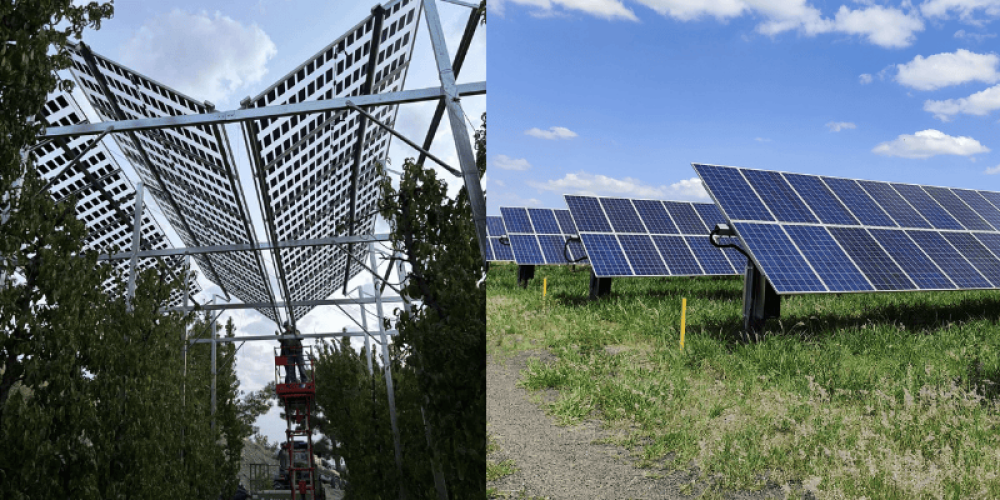
Agrivoltaics, often called Agri-PV, describes agricultural systems where solar technology is integrated into farming activity rather than replacing it. The land remains productive. Crops continue to grow. Machinery still moves through the field. At the same time, electricity is generated on site.
The key difference from conventional solar installations is intent. Agrivoltaic systems are designed around agriculture first. Light availability, crop sensitivity, airflow, irrigation patterns, and daily farm operations define the system design. Energy production is important, but it is never the only goal.
Why agrivoltaics fits the Dutch agricultural model
The Netherlands produces more food per hectare than almost any other country in the world. That efficiency did not come from expanding land use, but from smarter systems, better control, and continuous experimentation. Agrivoltaics follows the same logic.
Dutch farms face three structural pressures. First, land is scarce and expensive. Second, energy demand is high, especially in greenhouse horticulture. Third, weather volatility increasingly affects planning and risk management. Agrivoltaics does not solve all of these challenges, but it addresses them together rather than separately.
Instead of choosing between food production and energy generation, agrivoltaics allows both to coexist on the same footprint. Instead of treating climate protection, energy independence, and crop management as separate areas, it combines them into one system.
How agrivoltaic systems work in practice
There is no single agrivoltaic system that works everywhere. In practice, systems vary depending on crop type, location, and farming method.
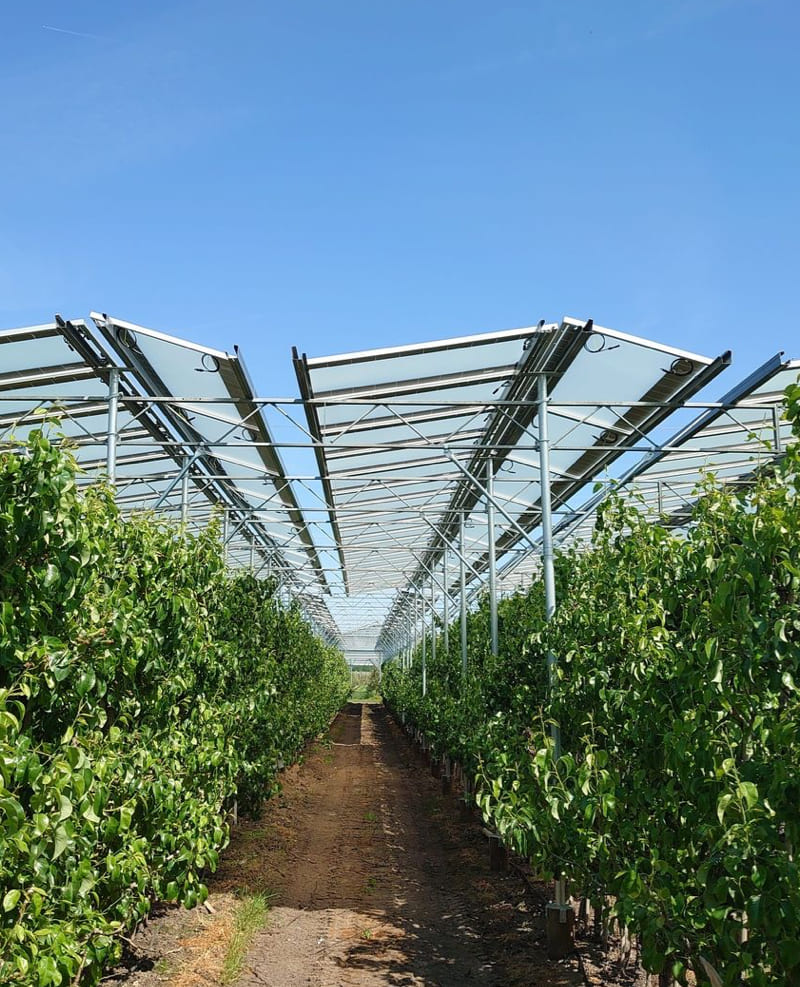
In open fields, agrivoltaic structures are typically elevated above the crop. Their height and spacing are designed to allow tractors, harvesters, and workers to operate normally. Panel density is carefully planned so that crops receive sufficient light throughout the growing season.
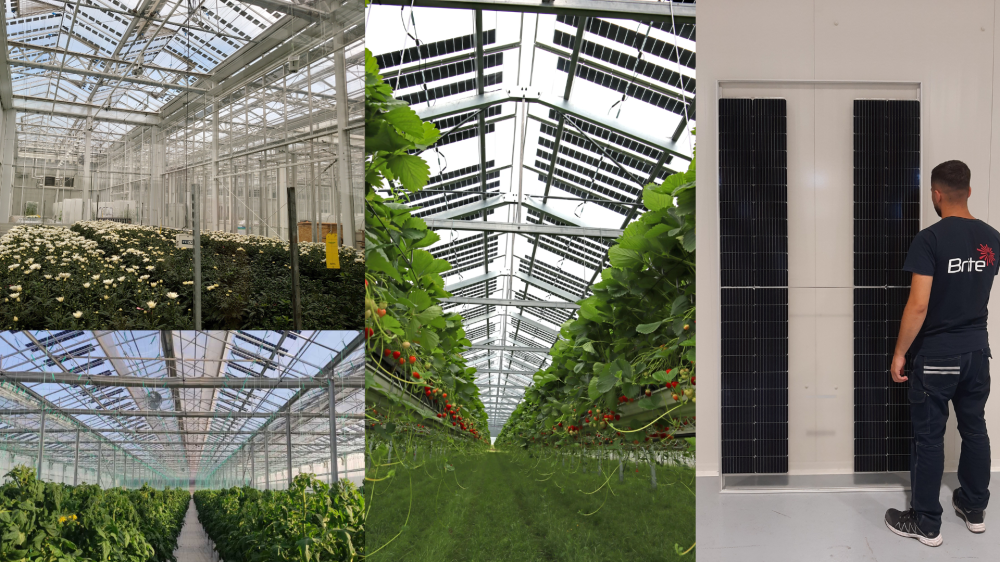
In greenhouse environments, agrivoltaics takes a different form. Semi-transparent photovoltaic glass is installed directly on the greenhouse roof, using the existing structure as its support. This approach is particularly efficient from an investment perspective, as it avoids the need for additional steel structures, which are required in open-field installations. Light transmission is not fixed. It is adjusted according to crop needs and local radiation levels. The goal is not to block sunlight, but to manage it more intelligently.
What matters most is that agrivoltaic systems are adapted, not standardized. Successful installations always begin with a site-specific study that looks at crops, climate, and energy demand together.
Agrivoltaics in Dutch greenhouses
Greenhouses are central to Dutch agriculture, and they are also among the most energy-intensive farming systems in Europe. Heating, cooling, ventilation, lighting, and irrigation all depend on reliable power.
Agrivoltaics in greenhouses is not about placing opaque panels on a roof. It is about integrating energy generation into the greenhouse envelope while preserving the light spectrum crops need to grow.
Brite Solar has tested this approach in the Netherlands through its ornamental plants greenhouse project in Naaldwijk. In this project, semi-transparent photovoltaic glass was used to study plant response, energy production, and overall greenhouse performance under Dutch climate conditions. You can explore the project here
The takeaway from greenhouse agrivoltaics is simple. When light management and crop needs guide the design, energy production becomes an added function rather than a trade-off.
Agrivoltaics in open field crops and orchards
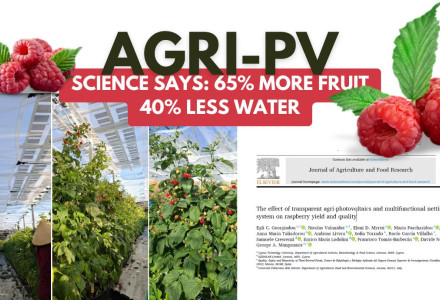
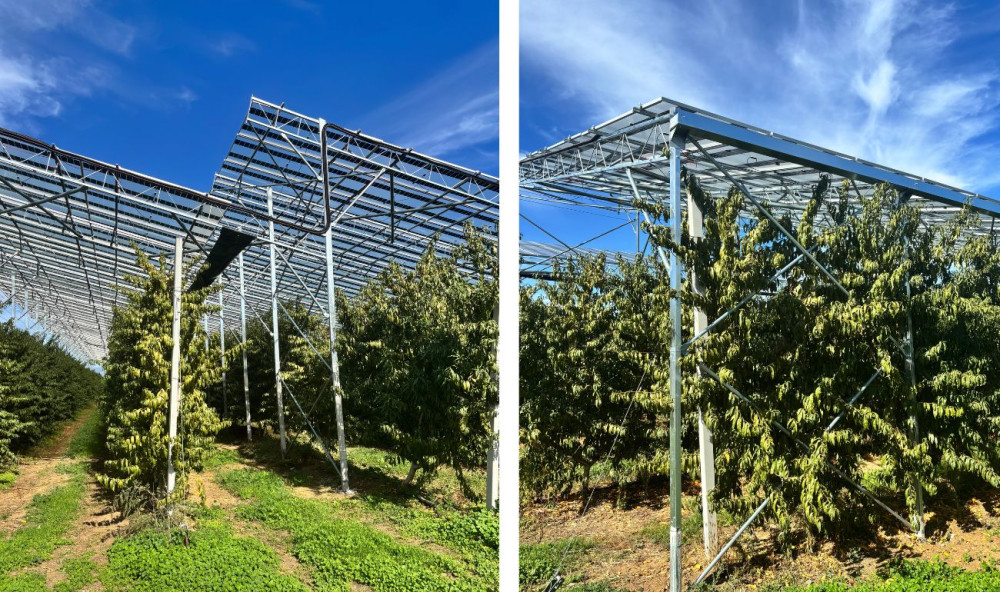
Open-field agrivoltaics in the Netherlands has focused mainly on perennial crops such as berries and fruit trees. These crops are particularly sensitive to weather extremes and benefit from partial protection without full enclosure.
A clear example is the open-field blueberry cultivation project in Broekhuizen. This installation explores how agrivoltaic structures interact with berry crops under Dutch conditions, focusing on crop protection, microclimate moderation, and operational feasibility
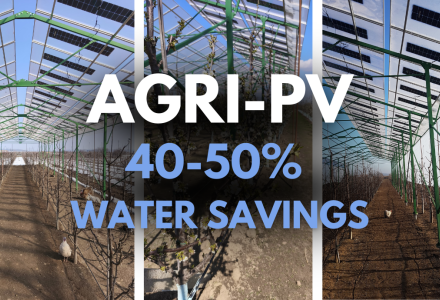
Another important reference is the open-field pear cultivation project in Papendrecht. Here, agrivoltaics was introduced as a response to climate-related risks while maintaining normal orchard operations
These projects show that agrivoltaics in open fields is not about maximizing shade. It is about creating a more stable growing environment while preserving access, visibility, and long-term orchard management.
Crops, light, and yield stability
One of the first questions farmers ask about agrivoltaics is whether it affects yields. The honest answer is that it depends. Different crops respond differently to changes in light intensity, temperature, and evaporation.
In many cases, partial shading reduces stress during heat peaks and slows water loss from the soil. This can support more stable growth, especially during increasingly common weather extremes. However, agrivoltaics is not designed to guarantee higher yields across all crops and all seasons.
In the Dutch agricultural mindset, stability often matters more than maximum output. Predictable quality, reduced risk, and consistent harvests are often more valuable than occasional peaks. Agrivoltaics aligns with this way of thinking when it is designed crop by crop, not imposed as a generic solution.
Agrivoltaics and climate resilience
Climate variability is no longer theoretical. Late frosts, hail events, short heat waves, and intense rainfall affect Dutch farms every year. Agrivoltaic structures can act as a layer of protection, moderating these extremes without fully enclosing crops.
Unlike plastic tunnels or nets, agrivoltaic systems combine protection with functionality. They do not just shield crops. They also produce energy and influence microclimate dynamics such as temperature and evaporation.
This is why agrivoltaics is seen as an energy solution and as part of farm infrastructure for resilience.
🗝️Read more about a real case where frost hit cherry trees and how agri-PV protected the crop.
Research and the Europe approach to agrivoltaics
Across Europe, agrivoltaics is taking shape through different national pathways, reflecting how each country balances agricultural priorities with energy policy. France has moved quickly by establishing a clear legal framework for agrivoltaics, encouraging solar development on farmland while explicitly safeguarding agricultural use. Germany has advanced through a strong emphasis on research, technical standards, and large-scale pilot projects, allowing agrivoltaic systems to be tested and deployed at increasing scale within its renewable energy strategy. In the Netherlands, adoption has been more selective and deliberate, centred on pilot installations, high-value crops, and close cooperation between growers, technology providers, and research institutions. Together, these approaches show that agrivoltaics is not a one-size-fits-all solution, but a flexible model that adapts to national farming systems, regulatory cultures, and long-term sustainability goals.
Brite Solar nanocoating technology
In the case of Brite Solar, the technology is based on nanocoating designed for agricultural applications and patented by the company. The operating principle is the conversion of UV radiation in the red spectrum, where photosynthesis takes place. This optimizes the quality of light reaching the plants, while also generating energy. The transparency of the panels is defined on a project-by-project basis, depending on the crop and the climatic conditions of the area, so that the solution is practical and not a "one size fits all" approach.
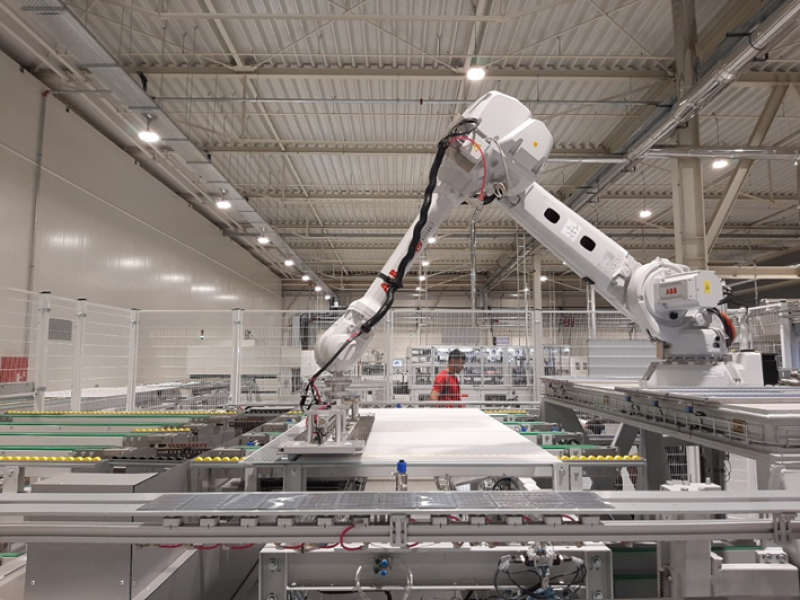
Brite Solar is a Greek nanotechnology company with a production base in Patras, where it operates its factory for the manufacture of transparens Agri PV panels. Producing in Europe leads to better quality control. It also provides more direct technical support and faster delivery for projects in the European market. The technology is specially designed for agricultural use.
Is agrivoltaics right for every farm
Agrivoltaics is not a universal solution. It requires planning, investment, and a willingness to think long term. It makes the most sense where energy demand is significant, where crops benefit from partial protection, and where land is managed with a long planning horizon.
For some farms, other energy solutions may be more appropriate. For others, agrivoltaics can become part of a broader strategy focused on resilience, autonomy, and efficient land use.
The key is alignment. When the system matches the farm, agrivoltaics becomes a tool rather than a compromise.
Frequently asked questions about agrivoltaics in the Netherlands
📍What is agrivoltaics
Agrivoltaics is a farming approach that combines agricultural production and solar energy generation on the same land, using systems designed to maintain crop growth and farm operations.
📍Does agrivoltaics reduce crop yields
Agrivoltaics is designed to support agricultural production, not reduce it. When systems are properly designed around the needs of each crop, yields can be maintained while crops benefit from a more stable growing environment. Outcomes vary by crop and location, but many agrivoltaic projects prioritise consistency and risk reduction, helping farmers protect production rather than compromise it.
📍Can agrivoltaics be used in Dutch greenhouses
Yes. In the Netherlands, agrivoltaics is often applied in greenhouses using semi-transparent photovoltaic glass that integrates with existing climate and light management systems.
📍Is agrivoltaics allowed in the Netherlands
Agrivoltaics is assessed within existing agricultural and energy planning frameworks. Approval typically depends on maintaining agricultural use and meeting local regulations.
📍How is agrivoltaics different from rooftop solar
Rooftop solar uses existing buildings and does not interact with crops. Agrivoltaics integrates energy generation directly into farming systems and influences the growing environment.
Communicate with us to learn more about your crop:
🟥 Phone.: +30 2310 321342
🟥 Email: info@britesolar.com